5km Rowing Ergo Test Calculator
Quick Answer
This calculator rates your 5000 meter rowing ergometer test performance and provides training insights. Enter your time and body weight to see how you compare to established rowing standards.
- Calculates performance category based on Concept2 standards
- Provides average 500m split, estimated watts, and calorie burn
- Validated alternative to the 3-mile run for US Marines (ages 46+)
The 5 km (5000 meters) Rowing Ergo Test is part of the testing for the US marines, as an alternate to the 3-mile run. There are also shorter versions of the ergo test, the 2km and 500m ergo test.
Test Purpose
As an alternative to a running test, the 5km rowing ergo test assesses aerobic fitness with significantly less stress on the lower body. This makes it ideal for athletes recovering from lower limb injuries, those with joint issues, or anyone seeking a challenging cardiovascular assessment without impact forces.
Equipment Required
A Concept IID rowing ergometer (or equivalent) is required. A specific drag factor needs to be set based on athlete weight and experience level—consult gym staff for appropriate settings.
Pre-Test Procedures
Explain the test procedures to the subject. Perform screening of health risks and obtain informed consent. Prepare forms and record basic information such as age, height, body weight, gender, and test conditions. Check and calibrate the equipment as required. Perform a standard warm-up consisting of 5-10 minutes of light rowing at 50-60% effort. See more details of pre-test procedures.
Test Procedure
Education and practice are required to ensure correct technique, which will ensure better results and also help prevent injury. Set an appropriate drag factor (typically 120-140 for most rowers). Set up the display to show the time and splits. Start from a stationary position, then row continuously for 5 km. The aim of the test is to cover the 5 km in the shortest possible time.
Experience has shown that better scores are achieved with an even split rather than starting conservatively and then coming home strong, or going out too fast and not being able to complete the distance.
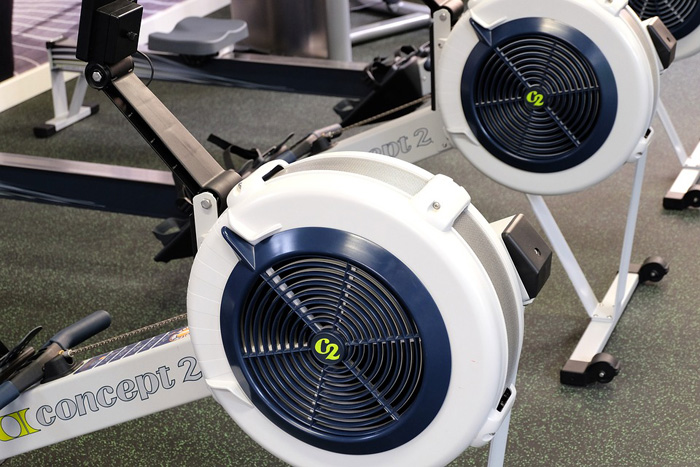 Concept 2 rowing ergometer - the standard equipment for the 5km ergo test
Scoring and Performance Standards
Record the time taken to complete the 5000 meters in minutes and seconds. The test may take between 15-30 minutes depending on fitness level. Performance categories are based on established rowing ergometer standards:
Elite (Men: <16:00, Women: <18:00)
Competitive/professional rowing standard. Exceptional aerobic capacity and rowing efficiency.
Excellent (Men: 16:00-18:00, Women: 18:00-20:00)
Club competition level. Strong aerobic base with good technique.
Good (Men: 18:00-20:00, Women: 20:00-22:00)
Well-trained recreational rower. Above average cardiovascular fitness.
Average (Men: 20:00-23:00, Women: 22:00-25:00)
Regular fitness level. Passes military fitness standards.
Target Population
The 5km rowing test is primarily used for US Marines aged 46 years and older as an alternative to running assessments. It is also widely used by:
- Competitive rowers monitoring training progress
- CrossFit athletes assessing rowing capacity
- Athletes rehabilitating from lower body injuries
- Military and first responder fitness programs
- Indoor rowing competition participants
Pacing Strategy
Good pacing is critically important for optimal 5km ergo performance. Research shows that even splits produce the fastest times. Too fast a start can lead to increased metabolic acidosis that will have a negative effect on aerobic energy production during the remainder of the test. This could lead to early fatigue and a deterioration in technique.
Pro Tip: Aim for negative splits—slightly faster in the final 1000m than your opening 1000m. This approach often produces best results while maintaining technique throughout. Strong verbal encouragement will help the subject achieve their maximal score.
The Science Behind the Calculation
Performance Formula
Our calculator uses established rowing ergometer power calculations to determine performance metrics. The relationship between pace and power follows this formula:
Watts = 2.80 / pace³
Where pace is measured in minutes per 500 meters. This cubic relationship means that small improvements in pace require significantly greater power output—a fundamental principle of rowing ergometer training.
Weight-Adjusted Performance
Since larger athletes have natural advantages in absolute power output, competitive rowing uses weight-adjusted times for fair comparison. The weight adjustment factor accounts for the additional power required to move greater body mass, allowing meaningful comparison between lightweight and heavyweight athletes.
Calculation Example
For an 85kg male completing 5km in 18:30 (1110 seconds):
- Average 500m pace: 1:51.0 (1.85 minutes)
- Estimated watts: 2.80 / (1.85/60)³ = approximately 220 watts
- Calories per hour: watts × 4 + 300 = approximately 1,180 cal/hr
- Performance category: Excellent
Sport-Specific Applications
Rowing and Water Sports
The 5km ergo test is the gold standard for assessing aerobic capacity in rowing. Elite rowers use this distance to evaluate training progress, with sub-16 minute times indicating world-class fitness. The test closely correlates with on-water performance in events from 2000m races to longer head races.
CrossFit and Functional Fitness
CrossFit competitions frequently include 5km rows as standalone events or within longer workouts. Athletes targeting the CrossFit Games typically aim for sub-17 minute times for men and sub-19 minutes for women.
Military Fitness
The US Marines accept the 5km row as an alternative to the 3-mile run for personnel aged 46 and older. This accommodation recognizes the equal cardiovascular challenge while reducing injury risk in mature athletes. Other military branches are adopting similar alternatives.
Rehabilitation and Return to Sport
Sports medicine practitioners frequently use rowing ergometry for athletes recovering from ACL reconstruction, ankle injuries, or stress fractures. The 5km test provides objective fitness data without loading healing structures.
Frequently Asked Questions
What is a good 5km rowing time?
A good 5km rowing time depends on age, gender, and fitness level. For recreational rowers, completing the distance under 22 minutes is considered good. Competitive club rowers typically finish under 19 minutes. Elite male rowers achieve times under 16 minutes, while elite female rowers complete it under 18 minutes.
How does the 5km row compare to running a 5K?
The 5km row and 5km run both provide excellent aerobic challenges but work the body differently. Rowing is a full-body exercise engaging approximately 86% of muscles versus running's lower-body focus. Elite 5km row times (15-17 minutes) are similar to competitive 5K running times, making them roughly equivalent fitness measures.
What drag factor should I use for the 5km rowing test?
Most rowers perform best with a drag factor between 120-140 for the 5km test. Lighter rowers (under 70kg) may prefer 110-125, while heavier rowers (over 90kg) might use 130-145. The key is finding a setting that allows sustainable power output without premature fatigue.
How often should I test my 5km rowing time?
For training monitoring, test every 4-8 weeks to track progress without overtraining. Competitive rowers often test at the beginning and end of training blocks. Allow at least 48 hours recovery before and after maximal 5km efforts.
Can I improve my 5km rowing time without rowing more?
Yes, supplementary training can improve 5km times. Core strengthening, leg power work, and interval training on other cardio equipment all transfer to rowing performance. However, rowing-specific practice remains essential for technique development and efficiency.
What stroke rate should I maintain for a 5km test?
Most successful 5km efforts use stroke rates between 24-28 strokes per minute. Higher rates (28-32) suit lighter, more technical rowers, while powerful athletes often achieve best times at lower rates (22-26) with greater force per stroke. Experiment in training to find your optimal rate.
Is the 5km row safe for beginners?
Yes, with proper technique instruction and appropriate pacing. Beginners should learn correct form before attempting maximal efforts and should start with shorter distances. Building up from 2km tests helps develop the fitness and technique needed for strong 5km performances.
References
- Concept2. (2024). "5000 Meter World Records and Standards." Concept2 Performance Monitors.
- United States Marine Corps. (2024). "Physical Fitness Test (PFT) Alternative Events." Marine Corps Order 6100.13A.
- Ingham, S.A., et al. (2002). "Determinants of 2,000 m rowing ergometer performance." European Journal of Applied Physiology, 88(3), 243-246.
- Lawton, T.W., et al. (2011). "Relationship between rowing performance and physical capacity in elite rowers." International Journal of Sports Physiology and Performance, 6(2), 185-195.
- Steinacker, J.M. (1993). "Physiological aspects of training in rowing." International Journal of Sports Medicine, 14, S3-S10.
- Wood, R.J. (2017). "Rowing Ergometer Testing Protocols." TopEndSports Fitness Testing Guide.
- Secher, N.H. (1993). "Physiological and biomechanical aspects of rowing." Sports Medicine, 15(1), 24-42.
The Test in Action
- This test is part of the testing for the US marines
Similar Tests
- 2000m (2km) rowing ergometer test — aim to cover the 2km in the shortest possible time.
- 500m ergo test — aim to cover the 500m in the shortest possible time.
- Rowing Beep Test — incremental test performed on a rowing ergometer
Related Pages
- Other aerobic tests
- Rowing fitness testing
- Rowing Ergometers for Fitness Testing
- Testing for the US Marines
- About the sport of rowing, which includes indoor rowing competitions
 Any comments, suggestions, or corrections? Please let us know.