PFT Sit-Up (Crunches) Calculator
Quick Answer
This calculator determines your USMC PFT crunch score based on official Marine Corps scoring standards. Enter your age, gender, and crunch count to instantly see your points and performance classification.
- Calculates PFT points from 0-100 based on MCO 6100.13A standards
- Shows minimum crunches required for your age group
- Provides performance classification (First/Second/Third Class)
About the PFT Sit-Up (Crunches) Test
The sit-up test is a measure of the endurance of the abdominal and hip-flexor muscles. The aim of this test is to perform as many sit-ups as you can in two minutes. This test formed part of the US Marine Physical Fitness Test (PFT) from 1996 until December 31, 2022, when it was replaced by the plank hold.
Test Purpose: This test measures the muscular endurance of the abdominal and hip-flexor muscles, which are essential for core stability, combat readiness, and overall athletic performance.
Equipment Required: Flat ground surface, stopwatch, and optionally a partner to hold feet.
How to Use This Calculator
Follow these steps to calculate your PFT crunch score:
- Enter Your Age: Input your current age in years (17-99). Different age groups have different scoring standards.
- Select Your Gender: Choose male or female, as scoring tables differ between genders.
- Enter Your Crunch Count: Input the total number of properly executed crunches completed in 2 minutes.
- Click Calculate: Your PFT points, classification, and performance feedback will be displayed instantly.
PFT Crunches Test Procedure
Pre-test: Explain the test procedures to the subject. Perform screening of health risks and obtain informed consent. Prepare forms and record basic information such as age, height, body weight, gender, and test conditions. Perform an appropriate warm-up. See more details of pre-test procedures.
Procedure: The aim of this test is to perform as many sit-ups as you can in two minutes. The starting position is lying on your back with your knees bent and feet flat on the floor. The arms are folded across the chest, and must maintain no gap between the forearms and the chest at all times. A second person is permitted to hold the lower legs or ankles. On the command 'go,' start the crunch by raising your upper body forward until the elbows or forearms touch the thighs, and then lower the torso until the shoulder blades touch the ground. This is one complete sit-up.
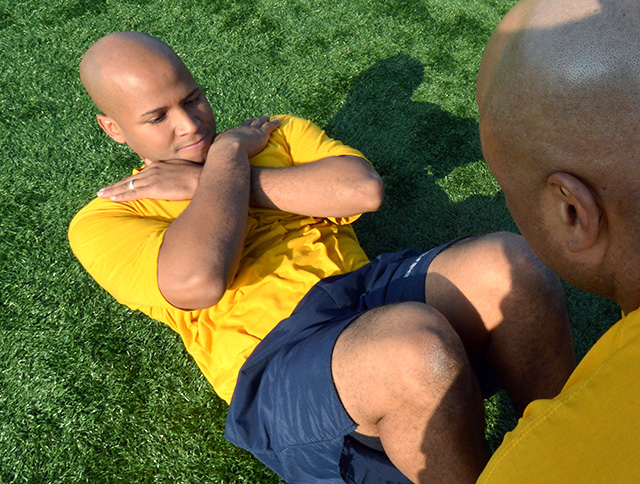
The Marine sit-up assessment technique
Comments: No bouncing or arching of the lower back is allowed, and the buttocks must remain in constant contact with the floor throughout the test. Resting during the exercise is permitted in either the up or the down position.
PFT Crunch Scoring Tables
The following tables show the official USMC PFT crunch scoring standards based on Marine Corps Order (MCO) 6100.13A. Points are calculated based on the number of crunches completed within the 2-minute time limit.
Male Crunch Standards
| Age Group | Min Crunches (40 pts) |
Max Crunches (100 pts) |
|---|---|---|
| 17-20 | 70 | 105 |
| 21-25 | 70 | 110 |
| 26-30 | 70 | 115 |
| 31-35 | 70 | 115 |
| 36-40 | 70 | 110 |
| 41-45 | 65 | 105 |
| 46-50 | 50 | 100 |
| 51+ | 40 | 100 |
Female Crunch Standards
| Age Group | Min Crunches (40 pts) |
Max Crunches (100 pts) |
|---|---|---|
| 17-20 | 50 | 100 |
| 21-25 | 55 | 105 |
| 26-30 | 60 | 110 |
| 31-35 | 60 | 105 |
| 36-40 | 60 | 105 |
| 41-45 | 55 | 100 |
| 46-50 | 50 | 100 |
| 51+ | 40 | 100 |
Understanding Your PFT Score Classification
The USMC uses a classification system to rate overall PFT performance. While this calculator focuses on the crunch event only, here's how point totals (across all three events) translate to fitness classification:
| Classification | Total PFT Points | Description |
|---|---|---|
| First Class | 235-300 | Exceeds standards; excellent physical conditioning |
| Second Class | 200-234 | Meets standards; good physical conditioning |
| Third Class | 150-199 | Minimum acceptable; needs improvement |
| Unqualified | Below 150 | Does not meet minimum requirements |
Training Tips to Improve Your Crunch Score
Based on sports science research and military fitness training protocols, here are evidence-based strategies to improve your PFT crunch performance:
Progressive Training Protocol
- Volume Training: Practice 3-4 sets of maximum crunches with 2-minute rest intervals, 3 times per week
- Endurance Focus: Perform timed 2-minute crunch sets to simulate test conditions
- Core Strengthening: Include planks, dead bugs, and leg raises to build overall abdominal strength
- Breathing Technique: Exhale on the way up, inhale on the way down to maintain rhythm
- Pacing Strategy: Start at a sustainable pace; most Marines find success with 40-50 crunches in the first minute
The Test in Action
- This test formed part of the US Marine Physical Fitness Test (PFT) until December 2022
- Marines conducted PFT testing semi-annually between January 1 and June 30
- The crunch test was used alongside pull-ups/push-ups and a 3-mile run
Frequently Asked Questions
How many crunches do I need to pass the Marine PFT?
The minimum crunches required varies by age group: 70 for males ages 17-40, 65 for ages 41-45, 50 for ages 46-50, and 40 for ages 51+. Females have lower minimums ranging from 40-60 depending on age. You must score at least 40 points on the crunch event to pass.
What is the maximum score for PFT crunches?
The maximum score is 100 points. For males aged 26-35, you need 115 crunches to max the event. For females aged 26-30, you need 110 crunches. Requirements to achieve maximum score vary by age group, with older age groups requiring fewer repetitions.
Are crunches still part of the Marine PFT?
No, as of January 1, 2023, crunches were officially replaced by the plank hold as the abdominal assessment in the USMC PFT. The plank is now the only authorized event for testing core endurance. However, crunch standards remain useful for training, fitness benchmarking, and historical reference.
How long do you have to complete PFT crunches?
Marines have exactly 2 minutes to complete as many crunches as possible. The test begins on the command 'go' and ends after 120 seconds. Resting is permitted in either the up or down position during the test, though this reduces the number of repetitions possible.
What is the proper form for PFT crunches?
Start lying on your back with knees bent at approximately 90 degrees and feet flat on the floor. Arms are folded across the chest with no gap between forearms and chest. Raise your upper body until elbows or forearms touch thighs, then lower until shoulder blades touch the ground. A partner may hold ankles, and buttocks must remain in contact with the floor throughout.
What's the difference between PFT crunches and regular sit-ups?
PFT crunches have specific form requirements: arms crossed on chest (not behind head), raising only until elbows touch thighs (not sitting fully upright), and shoulder blades must touch the ground between reps. This reduces hip flexor involvement and focuses the work on the abdominal muscles compared to full sit-ups.
Why did the Marines replace crunches with planks?
The Marine Corps determined that the plank is a better assessment of core stability and functional strength while reducing the risk of lower back injury associated with high-volume crunch training. The plank also better reflects the isometric core demands Marines face in combat situations and requires consistent total-body engagement.
References
- United States Marine Corps. (2022). "Marine Corps Order 6100.13A: Marine Corps Physical Fitness and Combat Fitness Tests." HQMC.
- Marine Corps Fitness. (2022). "PFT/CFT Standards." fitness.marines.mil.
- American College of Sports Medicine. (2021). "ACSM's Guidelines for Exercise Testing and Prescription." Wolters Kluwer.
- National Strength and Conditioning Association. (2016). "Essentials of Strength Training and Conditioning." Human Kinetics.
- Robertson, R.J. & Noble, B.J. (1997). "Perception of physical exertion: Methods, mediators, and applications." Exercise and Sport Sciences Reviews, 25, 407-452.
Similar Tests
- The APFT sit-up test procedure (U.S. Army)
- General Abdominal Endurance Test description
- The Navy PRT sit-up test
- Simple sit-up test that you can do at home
- The Eurofit 30 seconds sit-up test
- The Presidents Challenge sit-up test
Related Pages
- About Abdominal Testing
- PFT testing discussion and scoring
- Other speed and power tests, all fitness test list
- Sit up exercise at the beach or at home
- Sit Up World Records
 Any comments, suggestions, or corrections? Please let us know.