President's Challenge Curl-Up Test Calculator
Quick Answer
This calculator scores your President's Challenge Curl-Up Test performance using official 1985 School Population Fitness Survey standards. Enter your curl-ups completed in 60 seconds to instantly see your percentile ranking and fitness award level.
- Calculates percentile ranking by age and gender
- Determines Presidential (85th%), National (50th%), or Participant award level
- Based on validated PCPFS testing standards
The President's Challenge fitness award program has been largely replaced by those used for the FitnessGram Program. As such, the following curl up test has been replaced by the FitnessGram Curl-Up. However, with the return of the Presidential Fitness Test in 2025, these standards are once again relevant for schools implementing the program.
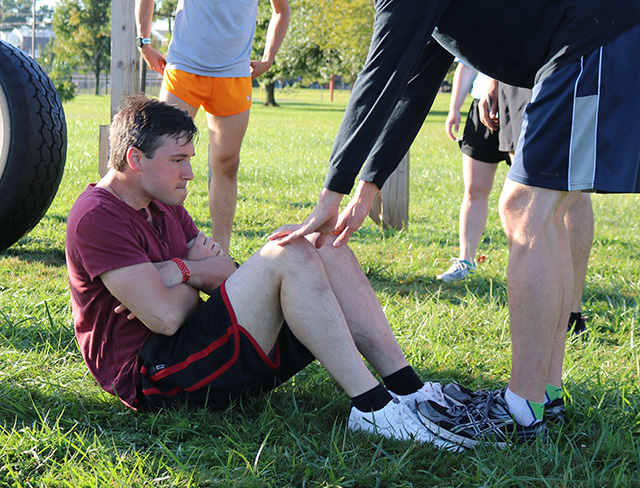 Proper curl-up form for the President's Challenge test
There are two variations of the curl-up test which were used in testing for the President's Challenge - the 'curl-up test' and the improved 'partial curl-up'. The procedure for the standard and original curl up test is described below, in which the subject performs the maximum number of curl-ups in one minute. The procedure was improved for the President's Challenge partial curl-up test.
See the general guidelines for Abdominal Endurance Tests. There is also a similar simple sit-up test that you can do at home, or the 2-minute sit-up test performed in the US Army and US Marines and US Navy.
How to Perform the President's Challenge Curl-Up Test
Test Purpose: The curl-up test measures abdominal strength and endurance, important in back support and core stability.
Equipment Required: You need a flat, clean, cushioned surface, stopwatch, recording sheets, and pen.
Pre-Test Procedures: Explain the test procedures to the subject. Perform screening of health risks and obtain informed consent. Prepare forms and record basic information such as age, height, body weight, gender, test conditions. See more details of pre-test procedures.
Procedure: The subject lies with knees flexed and feet approximately 12 inches from their buttocks. A partner assists by anchoring the feet to the ground. The arms are held flat across the chest, with the hands placed on opposite shoulders. The subject raises the trunk, keeping the arms in position, curling up to touch their elbows to thighs and then lowers back to the floor so that the shoulder blades (upper back) touch the floor. The maximum number of curl-ups performed in one minute is recorded.
Scoring: The completion of one complete curl up counts as one. Make sure that the subject does not "bounce" off the floor - only correctly performed curl ups should be counted. The timer begins the test by calling out the signal "Ready? Go!". The stop watch is started at the same time, and at the conclusion of one minute the timer calls out "Stop" at which counting and the subject stop.
Understanding Your Curl-Up Test Results
The President's Challenge uses a percentile-based scoring system to evaluate performance. Your curl-up count is compared against national data from the 1985 School Population Fitness Survey, adjusted for your age and gender.
Award Levels
There are three award categories to recognize student achievement in the President's Challenge program:
- Presidential Physical Fitness Award (85th Percentile): This prestigious award recognizes outstanding physical fitness. Students must score at or above the 85th percentile on all five events. For curl-ups, this typically means performing 45-55+ repetitions depending on age and gender.
- National Physical Fitness Award (50th Percentile): This award recognizes students who demonstrate a solid level of physical fitness. Students must score at or above the 50th percentile on all five events.
- Participant Award: Students who complete all test events but fall below the 50th percentile receive recognition for their participation and effort.
85th Percentile Standards (Presidential Award)
To earn the Presidential Fitness Award for curl-ups, here are the minimum scores required:
Advantages and Disadvantages of the Curl-Up Test
Advantages: This test is simple and quick to perform requiring minimal equipment, and large groups may be tested at once.
Disadvantages: A curl up with the feet held increases the involvement of the hip flexor muscles, making the test less valid as a measure of abdominal strength. The partial curl up test, in which the feet are not supported, is therefore a better measure of abdominal strength and endurance.
Comments: The partner may assist by counting aloud the number of repetitions. It is important that the correct technique is used as described for accurate comparison to the norms. If using a variation of the test, the actual technique and procedure should be recorded with the results, and appropriate norm tables consulted.
Guidelines: Before conducting any fitness test, you should review each person's medical status to identify medical, orthopedic or other health problems that should be considered. Before starting, make sure the correct techniques for all tests are explained. (See the Fitness Testing Guidelines for more info)
Sport-Specific Applications
Abdominal strength and endurance, as measured by the curl-up test, is crucial across many sports:
- Combat Sports (Wrestling, MMA, Judo): Core strength is essential for takedowns, ground control, and generating power in strikes
- Gymnastics: Strong abdominals maintain body positions during flips, holds, and landings
- Swimming: Core stability improves body position and kick efficiency in the water
- Running/Athletics: Abdominal endurance helps maintain proper form during distance events
- Team Sports (Football, Soccer, Basketball): Core strength aids in balance, change of direction, and contact situations
How to Improve Your Curl-Up Score
If you're looking to improve your curl-up test performance, consider these training recommendations:
- Progressive Training: Start with sets of 15-20 curl-ups and gradually increase volume over 4-6 weeks
- Core Variety: Include planks, dead bugs, and bicycle crunches to develop overall core strength
- Practice Test Pace: Perform timed sets at your target pace to build muscular endurance specific to the test
- Recovery: Allow 48 hours between intense abdominal training sessions for proper recovery
- Consistency: Train abdominals 3-4 times per week for optimal improvement
Frequently Asked Questions
How many curl-ups do I need for the Presidential Fitness Award?
To earn the Presidential Fitness Award, you must score at or above the 85th percentile for your age and gender. For example, a 13-year-old boy needs at least 53 curl-ups in 60 seconds, while a 13-year-old girl needs at least 46 curl-ups. Use the calculator above for your specific requirements.
What is a good curl-up score for my age?
A good curl-up score (50th percentile) varies by age and gender. For boys, the 50th percentile ranges from 22 curl-ups at age 6 to 45 curl-ups at ages 14-15. For girls, it ranges from 23 curl-ups at age 6 to 37 curl-ups at ages 13-14. The calculator provides your exact percentile ranking.
How long is the President's Challenge Curl-Up Test?
The standard President's Challenge Curl-Up Test is performed for exactly 60 seconds (one minute). You complete as many proper curl-ups as possible within this time period. A partner holds your feet and a timer announces start and stop.
What is the difference between curl-ups and sit-ups?
In the President's Challenge curl-up test, you curl up until your elbows touch your thighs, with arms crossed on your chest. Traditional sit-ups often involve hands behind the head and coming up higher. Curl-ups better isolate the abdominal muscles with less hip flexor involvement.
Are the Presidential Fitness Test standards different for boys and girls?
Yes, the Presidential Fitness Test uses age- and gender-specific standards based on the 1985 School Population Fitness Survey. Boys and girls have different percentile requirements at each age level to account for physiological differences in muscle development.
Is the Presidential Fitness Test coming back in 2025?
Yes, in July 2025, an executive order was signed to bring back the Presidential Fitness Test in public schools nationwide. The test includes curl-ups (or sit-ups), pull-ups, the shuttle run, a 50-yard dash, and a one-mile run. Official 2025 scoring charts are expected to be released by the President's Council on Sports, Fitness & Nutrition.
Can adults take the curl-up test?
While the President's Challenge standards were designed for youth ages 6-17, adults can still use the test to assess abdominal endurance. The 17+ age category can provide a reference point, though adult-specific norms may differ. For adults, consider also using the home sit-up test which has adult norms available.
The Test in Action
- This test was part of the President's Challenge fitness award program
- The Presidential Fitness Test returned to schools nationwide in 2025
Similar Tests
- President's Challenge partial curl up test
- The similar Partial Curl Up Test used in the Connecticut Physical Fitness Test
- Simple sit-up test that you can do at home
- Sit-up tests procedures for the US Army and US Marines and US Navy
Related Pages
- Purchase the sit-up test audio file
- General Abdominal Endurance Test description
- About Abdominal Testing
- Online sit-up metronome where you can set your own pace
- Videos of Sit Up Fitness Tests
- President's Challenge Fitness Awards
- Sit up exercise at the beach or at home
- All fitness tests list
- Sit-Up World Records
References
- President's Council on Physical Fitness and Sports. (1985). "School Population Fitness Survey." Washington, DC: U.S. Department of Health and Human Services.
- American Alliance for Health, Physical Education, Recreation and Dance. (1988). "Physical Best: The AAHPERD Guide to Physical Fitness Education and Assessment." Reston, VA: AAHPERD.
- Plowman, S.A. & Meredith, M.D. (2013). "Fitnessgram/Activitygram Reference Guide." 4th Edition. Dallas, TX: The Cooper Institute.
- Corbin, C.B., Pangrazi, R.P., & Franks, B.D. (2000). "Definitions: Health, Fitness, and Physical Activity." President's Council on Physical Fitness and Sports Research Digest, 3(9).
- Knudson, D. & Johnston, D. (1995). "Validity and Reliability of a Bench Trunk-Curl Test of Abdominal Endurance." Journal of Strength and Conditioning Research, 9(3), 165-169.
- Robertson, L.D. & Magnusdottir, H. (1987). "Evaluation of Criteria Associated with Abdominal Fitness Testing." Research Quarterly for Exercise and Sport, 58(4), 355-359.
 Any comments, suggestions, or corrections? Please let us know.